The Structural DNA of Unsolved Problems
Harvard · 2013–2014 · Dartmouth · 2025–present
Role · Creator, lead
What would it mean to sequence the DNA of the world’s unsolved problems? A snakebite researcher in India and a WHO epidemiologist looking at the same crisis see different diseases. A sensor failing in a Brazilian pasture shares structural DNA with a sensor failing on an ocean buoy. The same regulatory mismatch blocks progress in digital therapeutics and traditional medicine.
The Problem Genome Project is a living collection of 500 unsolved problems across 19 domains, each tagged with eight structural genes — domain, constraint type, scale, failure mode, breakthrough needed, stakeholder complexity, temporal dynamics, and tractability. The patterns that emerge reveal something no individual expert could see: the deep structural repetitions that connect fields that have never heard of each other.
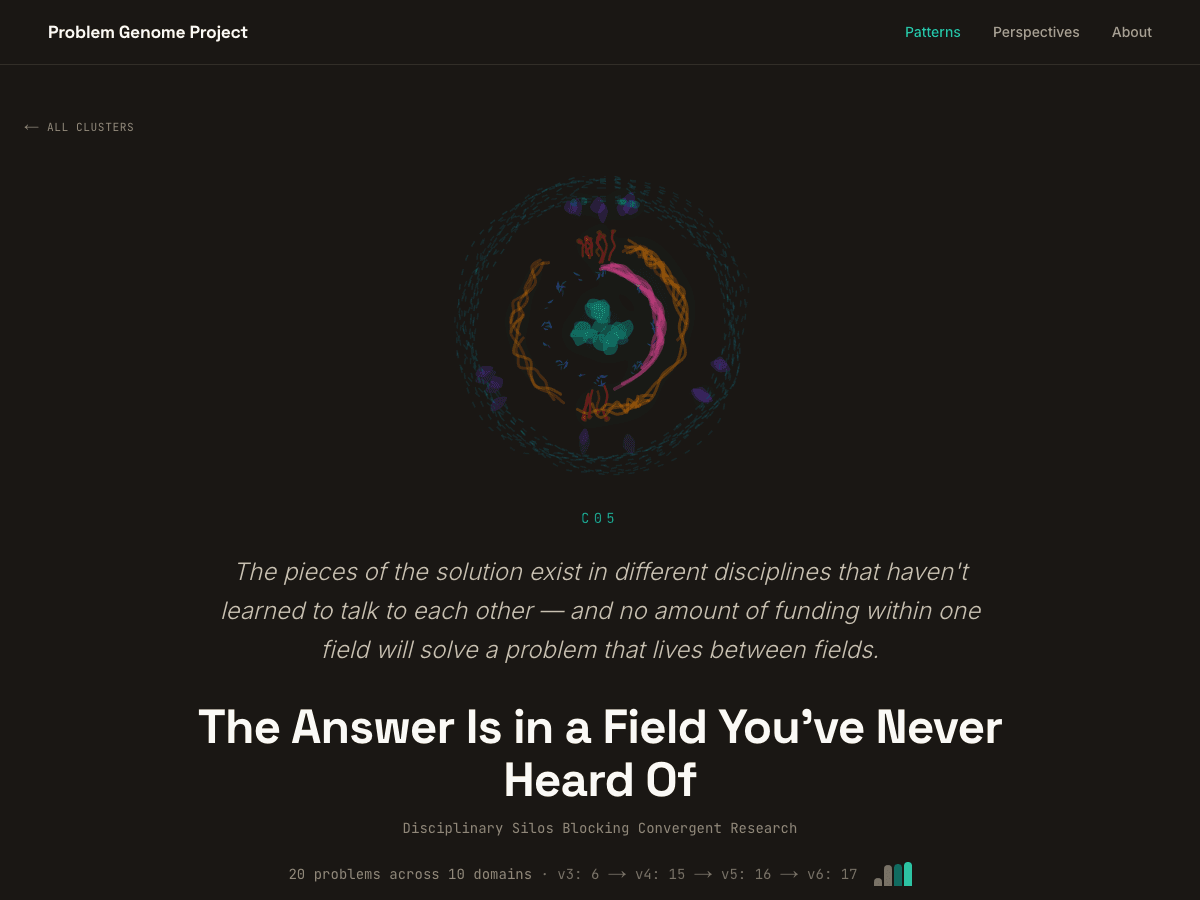
Each problem gets a generative ‘specimen’ — an organic visualization of its structural genome. When problems share DNA, their specimens look like relatives. 16 clusters have emerged so far, with names like ‘It Worked in the Lab,’ ‘The Solution Exists but Nobody Can Afford It,’ and ‘The Answer Is in a Field You’ve Never Heard Of.’
Originally funded by the Harvard Initiative for Learning and Teaching (HILT) in 2013–2014, the project was designed to make expert knowledge on important problems accessible at the outset of a project. New technologies and funding from Natural Artificial Labs at Dartmouth make the original vision possible at scale.
Originally funded by Harvard Initiative for Learning and Teaching (HILT). Current funding: Natural Artificial Labs, Thayer School of Engineering, Dartmouth College.