100 Ways of Seeing
Harvard SEAS · 2015–2021
Role · Artist-Researcher
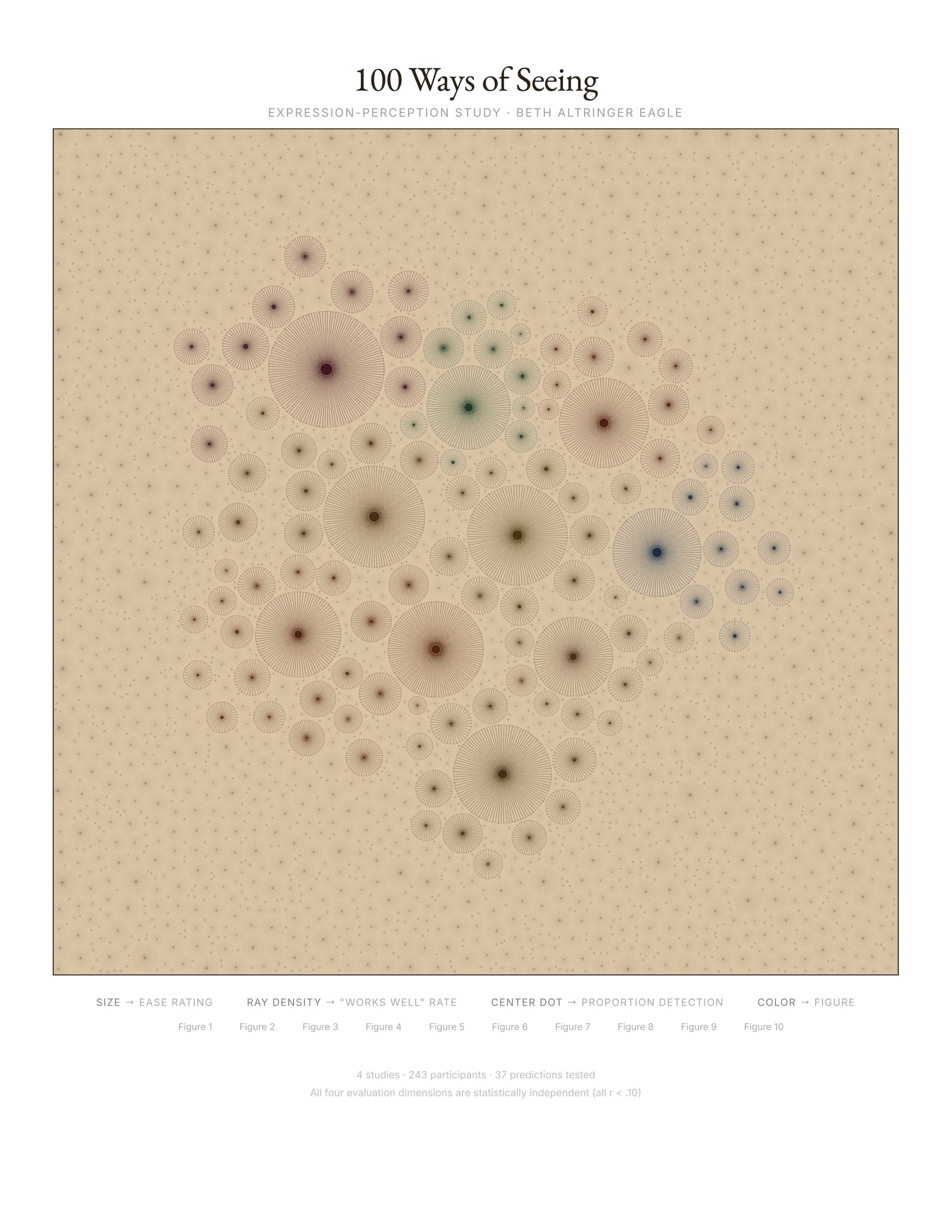
Design education often teaches that proportion, color harmony, and expert judgment converge into a quality called “good design.” This project tested that directly based on historical notions with 243 participants making perceptual ratings of 100 everyday design expressions in the form of wearable compositions.
Expert frameworks get the architecture right while getting the prescriptions wrong. Which dimensions matter and how they relate were confirmed. Which specific values are best were disconfirmed. Detection, quality, ease, and expert assessment turned out to be completely independent dimensions, not facets of one factor.
Raters converged on expressions that failed to communicate the wearer’s intentions but diverged on what “works.” When design creates no friction, individual taste fills the space.